

The campaign
Corda na Rua Promotion
A team of 63 performers in yellow and red streetclothes transformed jump rope into a street spectacle—first unbranded to spark rumors, then signed by Coca-Cola, across five capitals.
Client
Coca-Cola
Role
Creative
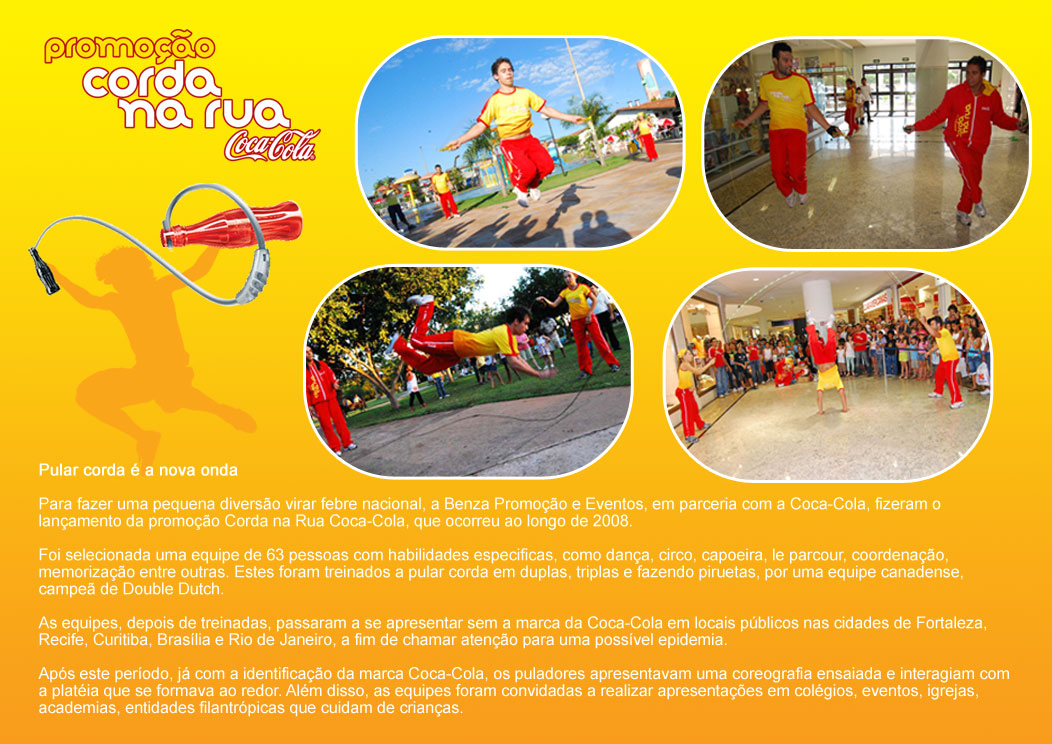
Jump rope is the new wave. To turn a small pastime into a national fever, Benza Promoção e Eventos, in partnership with Coca-Cola, launched the Corda na Rua Coca-Cola promotion, which swept through 2008 as an urban phenomenon.
Challenge
Reactivate the ritual of playing in the street at a time when youth were migrating to screens. It was necessary to create a symbol strong enough to spark conversation even before becoming a campaign—and once it became a campaign, to still feel spontaneous.
Approach
- 01
Curation of 63 performers blending dance, circus, capoeira, parkour, and motor coordination—profiles capable of handling the street routine.
- 02
Intensive training with a Canadian Double Dutch championship team to transform jump rope into duo and trio choreography.
- 03
Unbranded teaser phase in Fortaleza, Recife, Curitiba, Brasília, and Rio to install the rumor of a new urban wave.
- 04
Second phase with Coca-Cola branding, rehearsed choreography, and rollouts to schools, events, churches, gyms, and philanthropic organizations.
Videos
Coca-Cola Corda na Rua Promotion
0:31
Gallery
Deliverables
- 'Corda na Rua' concept and strategy
- Curation and training of the 63-performer team
- Activation plan in five capitals, in two phases (unbranded and branded)
- Script for the 30'' film and activation support materials
Context
A team of 63 people with specific skills—dance, circus, capoeira, parkour, coordination, and memorization—was selected. They were all trained to jump rope in pairs and trios while performing stunts by a Canadian champion Double Dutch team.
Once trained, the teams began performing without the Coca-Cola brand in public locations in Fortaleza, Recife, Curitiba, Brasília, and Rio de Janeiro, in order to draw attention to a potential 'epidemic.'
After this period, with Coca-Cola branding finally identified, the jumpers performed rehearsed choreography and interacted with the crowds that formed. The teams were also invited to perform in schools, events, churches, gyms, and philanthropic entities that care for children.
Outcome
Jump rope became a point of spontaneous discussion in the five activation cities—and by the time Coca-Cola signed the movement, the brand was already associated with a real street scene, not a commercial piece.
Credits
- Client
- Coca-Cola Brasil
- Agency
- Elipse Comunicação e Marketing
- Partner
- Benza Promoção e Eventos
- Training
- Equipe canadense de Double Dutch
- Creative
- Bruno Rothstein e Fernando Blum